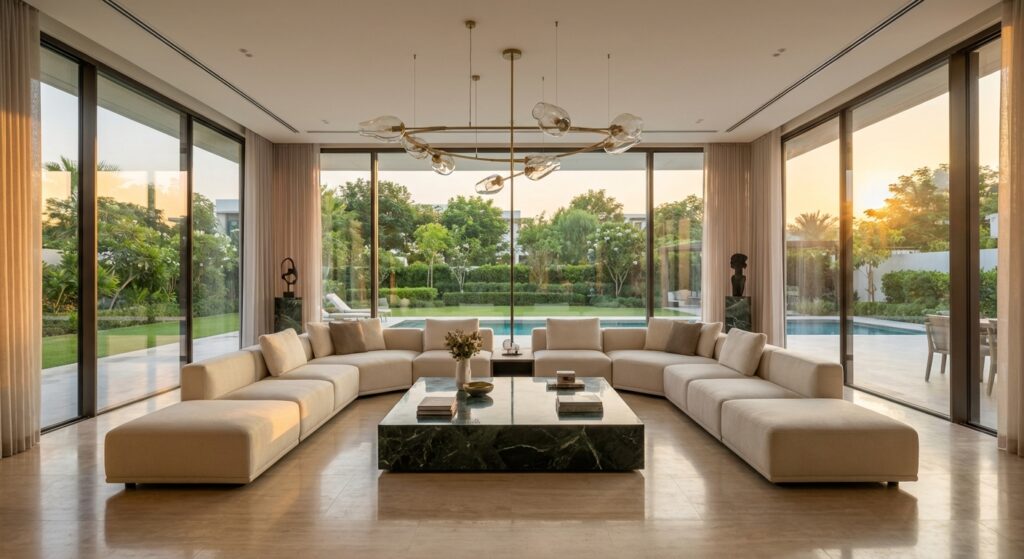
Along the limestone cliffs where the Amalfi Coast plunges into the Tyrrhenian Sea, centuries-old villas stand with walls thick enough to muffle the summer heat and cradle the winter sun. These structures represent more than architectural nostalgia. They embody a tested response to climate patterns that American estates from Santa Barbara to Palm Beach now replicate with remarkable precision. Working with premier Italian furniture firms like Modenese Furniture, whose portfolio spans both classical and contemporary Mediterranean traditions, designers are rediscovering that the romance of Mediterranean architecture rests not in ornament alone but in measurable thermal performance and spatial logic refined across generations.
The Mediterranean climate zone occupies a narrow band between 30 and 45 degrees latitude on western continental edges, creating identical conditions from Tuscany to coastal California. These regions receive less than 20 percent of annual precipitation during summer months, with most rainfall concentrated in cooler seasons. This seasonal rhythm shaped building traditions long before mechanical cooling existed. Thick masonry walls, interior courtyards, and strategic window placement evolved as direct responses to temperature swings that could reach 30 degrees Fahrenheit between day and night.
Climate Fundamentals and Architectural Response
According to NOAA’s National Centers for Environmental Information, Mediterranean climates are classified by annual precipitation between 300mm and 1300mm, with strong seasonal variation. The warmest month averages 72 degrees Fahrenheit, while winter temperatures remain above freezing. These conditions exist in only five global regions: the Mediterranean Basin, California, central Chile, South Africa’s Cape, and southwestern Australia.
| Climate Parameter | Mediterranean Range | Architectural Implication |
|---|---|---|
| Summer Precipitation | Less than 20% annual total | Minimal roof drainage systems, flat or low-pitch terra cotta tiles |
| Winter Temperature | Above 0°C (32°F) | No freeze protection needed, allows outdoor living spaces |
| Daily Temperature Swing | 15-30°F | High thermal mass walls to moderate interior conditions |
| Annual Rainfall | 300-1300mm (12-51 inches) | Courtyard drainage, cistern systems, minimal guttering |
Research from Oak Ridge National Laboratory demonstrates that massive wall construction provides what engineers term Dynamic Benefit for Massive Systems (DBMS). In testing across 10 American climate zones, masonry walls with thermal mass showed R-values that were up to 3.39 times higher than their steady-state calculations would suggest. The time lag between exterior heat gain and interior temperature rise ranged from 8 to 12 hours in walls exceeding 15 inches in thickness, effectively shifting peak cooling loads to evening hours when natural ventilation becomes viable.
Material Performance: Stone, Plaster, and Thermal Mass
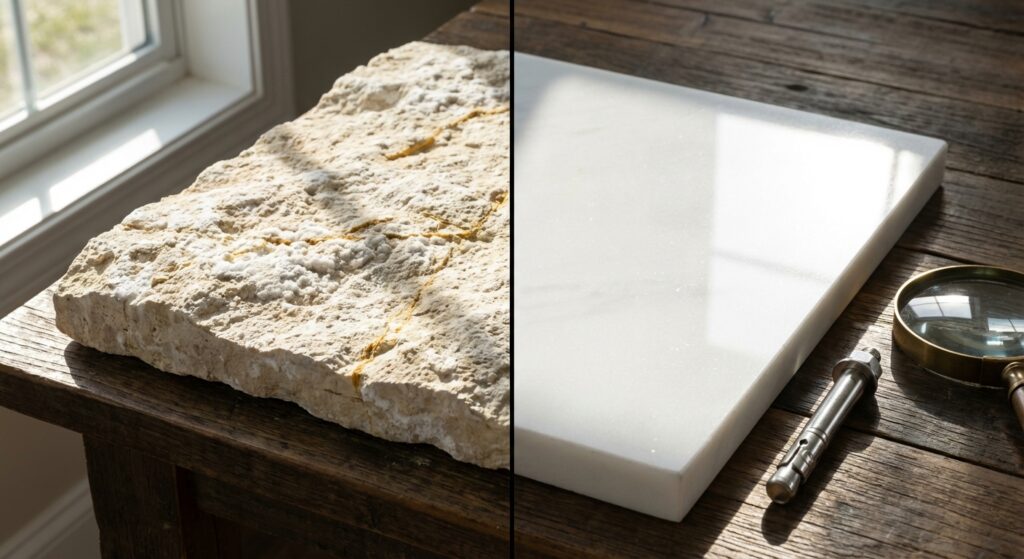
Traditional Mediterranean construction relied on locally quarried limestone, volcanic tufa, or clay brick, materials with specific heat capacities of 0.8-1.0 kJ/kg·K. Modern equivalents achieve similar performance through concrete, rammed earth, or insulated concrete forms. The critical factor is volumetric heat capacity, measured in joules per cubic meter per degree Kelvin.
| Material | Density (kg/m³) | Specific Heat (kJ/kg·K) | Thermal Conductivity (W/m·K) | Time Lag (8″ thickness) |
|---|---|---|---|---|
| Limestone | 2,300 | 0.91 | 1.3-1.7 | 6-8 hours |
| Clay Brick | 1,920 | 0.84 | 0.6-1.0 | 5-7 hours |
| Concrete (normal weight) | 2,400 | 0.88 | 1.4-2.0 | 7-9 hours |
| Rammed Earth | 1,800 | 0.84 | 0.5-0.9 | 8-10 hours |
| Wood Frame (comparison) | 600 | 1.21 | 0.12 | 1-2 hours |
Field studies documented by the Brick Industry Association show that a three-wythe brick wall (approximately 12 inches total thickness) with lime mortar joints provides thermal resistance beyond what steady-state R-value calculations predict. In field monitoring conducted in Maryland climates, such walls demonstrated 18-23% lower cooling energy consumption than insulated wood-frame construction of equivalent calculated R-value, primarily because the thermal mass moderates peak afternoon loads.
The Arc and the Arch: Structural Logic Made Visible
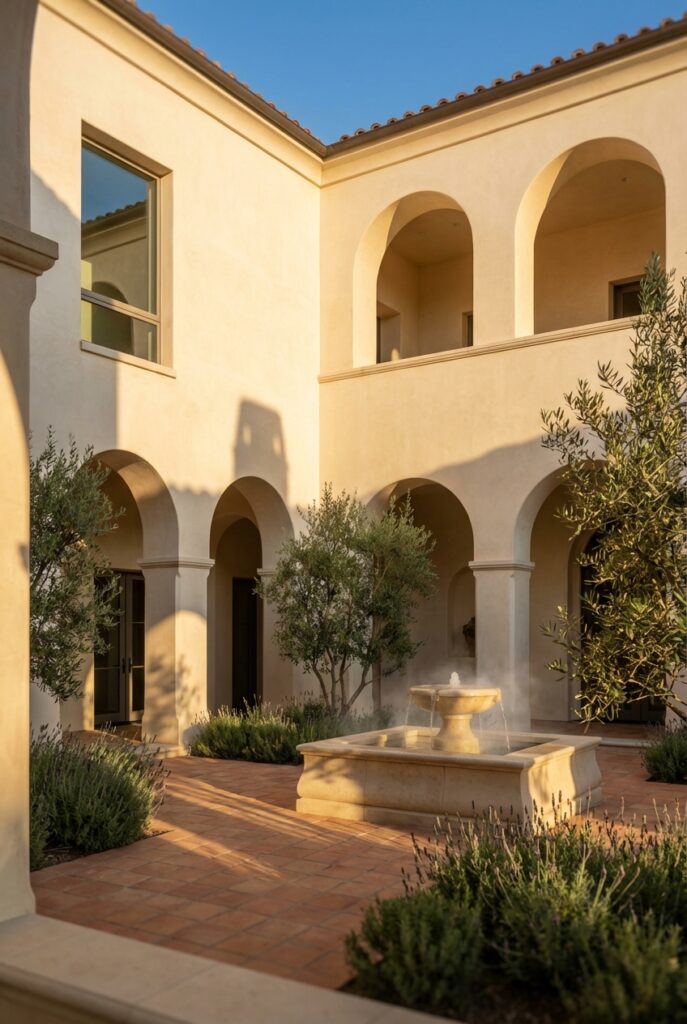
Mediterranean architecture made structural expression its decorative vocabulary. The semicircular arch, inherited from Roman engineering, appears in doorways, windows, loggias, and covered walkways not as a stylistic flourish but as the most efficient method of spanning openings in masonry construction. Unlike post-and-lintel systems, which concentrate loads, arches distribute compressive forces along their curves, allowing thinner walls and larger openings.
Contemporary applications translate this principle through cast concrete, prefabricated masonry arches, or composite systems that maintain visual authenticity while meeting modern structural codes. A typical residential window opening of 48 inches in width requires a segmental arch with a rise-to-span ratio between 1:4 and 1:6. Smaller ratios create nearly flat arches prone to cracking; larger ratios waste vertical clearance and appear stilted.
Arch Geometry Specifications
| Opening Width | Recommended Rise | Voussoir Count | Keystone Width | Springer Angle |
|---|---|---|---|---|
| 36 inches | 7-9 inches | 11-13 | 4-5 inches | 60-65° |
| 48 inches | 9-12 inches | 13-17 | 5-6 inches | 60-65° |
| 60 inches | 12-15 inches | 17-21 | 6-7 inches | 60-65° |
| 72 inches | 14-18 inches | 19-23 | 7-8 inches | 60-65° |
Wrought Iron: Medieval Craft Meets Modern Function
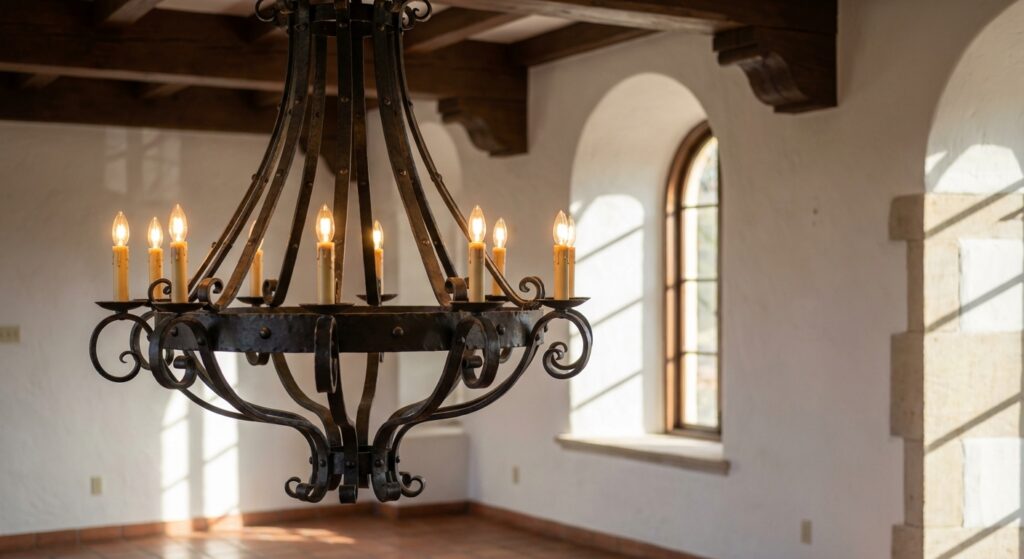
The wrought iron chandelier emerged from necessity in medieval European castles, where central rings held candles above great halls. By the 16th century, Spanish Colonial expansion brought forged-iron techniques to the Americas, where artisans combined European scrollwork with indigenous geometric patterns. These fixtures evolved from simple candle holders into architectural statements featuring hand-hammered curves, riveted joints, and surface textures impossible to replicate through casting.
Modern wrought iron fabrication maintains traditional forging methods while incorporating UL-listed electrical components and earthquake-rated mounting systems. True wrought iron, distinct from cast or tubular steel, contains less than 0.08% carbon and exhibits fibrous grain structure visible in the hammer marks. When heated to 2,300 degrees Fahrenheit, it becomes malleable enough to shape but retains strength superior to mild steel once cooled.
Wrought Iron Chandelier Specifications
| Room Height | Chandelier Diameter | Hanging Height Above Floor | Arm Count | Total Wattage |
|---|---|---|---|---|
| 8-9 feet | 20-24 inches | 6.5-7 feet | 3-5 | 180-300W |
| 9-10 feet | 24-30 inches | 7-7.5 feet | 5-6 | 300-360W |
| 10-12 feet | 30-36 inches | 7.5-8 feet | 6-8 | 360-480W |
| 12-14 feet | 36-42 inches | 8-9 feet | 8-12 | 480-720W |
| Over 14 feet | 42-60 inches | 9-10 feet | 12-18 | 720-1080W |
Installation requires calculating structural loads beyond the fixture weight. A 60-inch diameter chandelier weighing 120 pounds generates dynamic loads during earthquakes or wind vibration that can exceed 300 pounds. Ceiling joists must provide blocking rated for three times the static weight, and chain or rod suspension systems should incorporate swivels to prevent torsional stress.
Simplicity as Refinement: The Modern Mediterranean Reduction
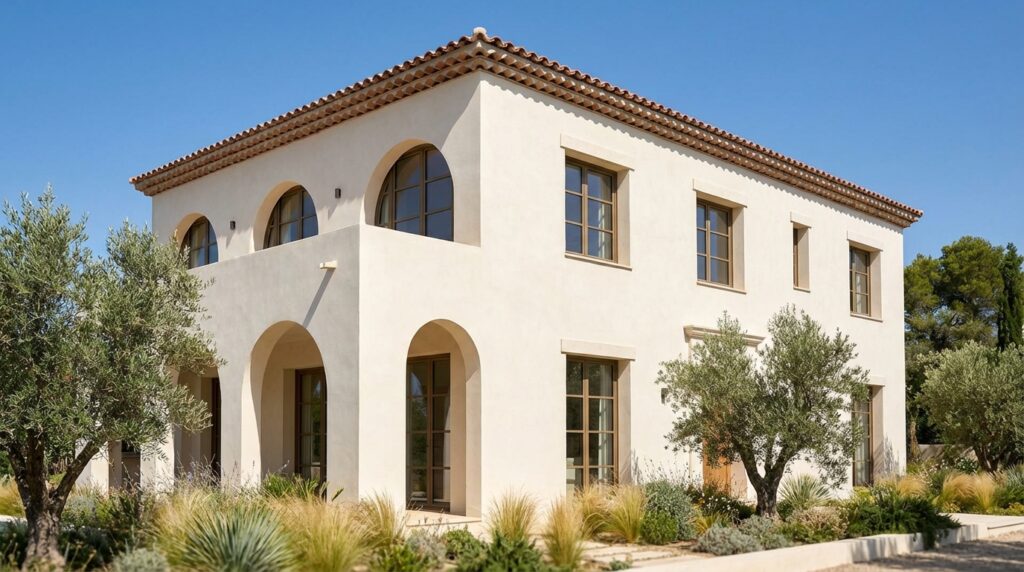
The twenty-first-century Mediterranean Revival diverges from early 20th-century interpretations that layered ornament without restraint. Contemporary approaches reduce decorative elements to essential structural expressions. Window surrounds receive simple limestone lintels rather than elaborate corbels. Interior plaster remains white or earth-toned, without trompe-l’œil or faux finishes. Tilework focuses on functional zones, such as kitchen backsplashes and bathroom floors, rather than covering every surface.
This reduction responds partly to construction economics but primarily to evolving aesthetic preferences that value material honesty over applied decoration. When architects specify 12-inch-thick concrete walls, they expose the material rather than concealing it behind layers of finish. Terra cotta roof tiles serve as functional weather protection, their overlapping geometry creating shadow lines that provide visual interest.
Material Palette: Comparative Analysis
| Element | Traditional Approach | Contemporary Interpretation | Performance Difference |
|---|---|---|---|
| Exterior Walls | 18-24″ stone, irregular coursing | 12-15″ insulated concrete, smooth finish | Equivalent R-value, 40% faster construction |
| Roof | Clay barrel tiles, 6:12 pitch | Concrete S-tiles, 4:12 pitch | 50-year vs 30-year lifespan |
| Flooring | Terracotta pavers, 12×12″ | Porcelain tile, 24×24″, terra cotta finish | Lower maintenance, higher durability |
| Windows | Single-pane, wood frame | Double-pane low-E, wood or aluminum-clad | U-factor 0.30 vs 1.0, 70% heat gain reduction |
| Plaster | Lime-based, hand-troweled | Acrylic-modified, spray-applied base coat | Faster curing, improved crack resistance |
Energy Performance in Practice
Data from the U.S. Department of Energy indicates that properly designed thermal mass buildings in Mediterranean climates can reduce annual HVAC energy consumption by 25-40% compared to lightweight construction. This advantage is greater in regions with large diurnal temperature swings, where nighttime temperatures drop 20-25 degrees below daytime highs.
The mechanism operates through thermal damping and phase shifting. During summer days, exterior wall surfaces may reach 140 degrees Fahrenheit under direct sunlight. In a lightweight wood frame wall, this heat conducts to the interior within 1-2 hours. In a 15-inch masonry wall, the same heat takes 8-10 hours to penetrate, reaching interior surfaces during evening hours when windows can open for natural ventilation. Winter operation reverses the benefit, with daytime solar gain stored in mass and released overnight as radiant heat.
Annual Energy Comparison (2,400 sq ft residence, California Climate Zone 10)
| Construction Type | Cooling (kWh) | Heating (therms) | Total Energy Cost | Peak Demand (kW) |
|---|---|---|---|---|
| Wood frame, R-19 walls | 4,200 | 380 | $1,340 | 5.2 |
| ICF, R-23 equivalent | 3,100 | 290 | $980 | 3.8 |
| 12″ concrete, exterior insulation | 2,850 | 275 | $920 | 3.5 |
| Traditional masonry, 18″ thick | 2,600 | 250 | $850 | 3.2 |
These figures assume identical floor plans, window areas (18% of floor area), and orientation (long axis east-west). Variables include wall R-value, thermal mass placement, and ventilation strategies. Research from ASHRAE confirms that thermal mass benefits peak when combined with night ventilation purging, where cool outdoor air flushes daytime heat from mass during evening hours.
Courtyard Morphology and Microclimate Control
Mediterranean villas are organized around interior courtyards for reasons beyond privacy. The courtyard functions as a thermal regulator, creating a microclimate 5-10 degrees cooler than surrounding streets through evaporative cooling, shade, and reduced air movement. A typical courtyard measuring 20 by 30 feet, enclosed by 12-foot walls, generates a stack effect that draws cool air from ground level and exhausts warm air above the roof line.
Water features amplify this effect through evaporative cooling. A fountain with a 4-square-foot water surface area, circulating 200 gallons per hour, can reduce ambient air temperature by 3-5 degrees within a 15-foot radius. This cooling operates without electricity consumption beyond a small recirculation pump drawing 40-60 watts.
Courtyard Design Variables
- Length-to-width ratio: 1.2:1 to 1.8:1 optimizes solar access in winter while providing summer shade
- Wall height-to-width ratio: 0.4 to 0.6 balances shade provision against excessive enclosure
- Paving albedo: Light-colored stone or concrete (albedo 0.5-0.7) reflects heat rather than absorbing it
- Vegetation coverage: 30-50% planted area provides evapotranspiration cooling without excessive moisture
- Opening orientation: Primary openings on the north and south walls maximize cross-ventilation
Window Strategies: Size, Placement, and Shading
Mediterranean architecture traditionally limited window sizes to reduce solar gain and maintain the structural integrity of masonry walls. Windows rarely exceeded 30% of wall area, and south-facing elevations received smaller openings than north-facing elevations. Deep windows, typically 12-18 inches in traditional construction, provide self-shading during high sun angles while admitting low-angle winter sun.
Modern glazing technology allows larger windows without proportional heat gain. Low-emissivity coatings and spectrally selective films can reduce the solar heat gain coefficient (SHGC) to 0.25 while maintaining visible transmittance above 0.60. This enables window-to-wall ratios approaching 25-30% on south elevations without exceeding cooling loads that traditional 15-20% ratios using clear glass would.
| Orientation | Traditional Ratio | Modern Ratio (low-E) | Shading Requirement | Recommended SHGC |
|---|---|---|---|---|
| North | 25-30% | 30-40% | Minimal | 0.40-0.50 |
| South | 15-20% | 25-30% | Horizontal overhang, 24-36″ projection | 0.25-0.35 |
| East | 10-15% | 15-20% | Vertical fins or vegetation | 0.25-0.30 |
| West | 10-15% | 12-18% | Deep reveals, shutters, or vegetation | 0.20-0.25 |
Color and Light: The Mediterranean Palette
The characteristic white walls of Mediterranean buildings serve functional purposes beyond aesthetics. High-albedo surfaces reflect 70-80% of incident solar radiation, keeping exterior wall surfaces 20-30 degrees cooler than dark colors. This reduces conductive heat transfer through the wall assembly and minimizes thermal stress from expansion and contraction.
Interior color schemes evolved to maximize natural light distribution in spaces with limited window area. White or cream plaster on walls and ceilings reflects daylight deeper into rooms, reducing reliance on artificial lighting. Earth tones derived from local minerals – ochre, sienna, umber – appear in tilework and accent walls, providing visual warmth without absorbing light from saturated hues.
Contemporary Applications: Case Parameters
Translating Mediterranean architecture to 21st-century American estates requires calibrating traditional forms to modern building codes, energy standards, and construction methods. Successful projects balance historical precedent with contemporary performance requirements through careful material selection and detailed design.
Code Compliance Considerations
- Structural engineering: Masonry walls require seismic reinforcement in zones 3-4, typically grouted cells with vertical rebar at 32-48 inches on center
- Energy codes: California Title 24, IECC, and ASHRAE 90.1 mandate minimum insulation levels often exceeding traditional construction; exterior continuous insulation or insulated concrete forms address this gap
- Fire resistance: One-hour rated assemblies standard for party walls and some exterior walls; 8-inch concrete or grouted CMU with plaster finish achieves this without additional protection
- Moisture management: Unlike Mediterranean climates with minimal summer rain, American regions require integrated weather barriers and flashing systems, not present in traditional construction
- Accessibility: ADA and Fair Housing Act requirements affect door widths, floor transitions, and bathroom layouts regardless of architectural style
Measured Outcomes: Performance Verification
Post-occupancy monitoring of Mediterranean Revival residences in California and Arizona demonstrates that thermal mass strategies deliver predicted energy savings when combined with proper ventilation control and occupant behavior. Homes with 12-inch concrete walls and night ventilation protocols had 32-38% lower cooling energy use than similar-sized wood-frame homes, closely matching DOE computer modeling predictions.
Peak demand reduction proved even more significant, with massive construction reducing maximum electrical draw by 40-45%. This translates to smaller HVAC equipment requirements and reduced utility demand charges. A 3,000-square-foot residence that would require a 4-ton air conditioning system in lightweight construction can often operate with 2.5-3 tons when incorporating thermal mass, saving $2,000-3,000 in equipment costs and $200-400 annually in reduced energy consumption.
Material Durability and Lifecycle Considerations
Mediterranean construction materials demonstrate exceptional longevity when properly detailed. Terra cotta roof tiles carry 50-75-year warranties, with documented lifespans exceeding 100 years. Limestone and concrete walls require minimal maintenance beyond periodic repainting or sealing. Wrought iron fixtures, when finished with hot-dip galvanization or powder coating, resist corrosion for decades even in coastal environments.
This durability significantly affects lifecycle cost analysis. While initial construction costs for masonry walls may exceed wood framing by 15-25%, reduced maintenance and energy savings recover the premium within 8-12 years. Over a 50-year building life, total ownership costs favor massive construction by 20-35% according to analysis from the National Institute of Standards and Technology.
The Villa Reimagined
Mediterranean Revival architecture for the 21st century synthesizes thermal performance data, structural efficiency, and spatial traditions into residences that function as climate machines wrapped in historical forms. The romance persists not as nostalgia but as recognition that certain building solutions transcend fashion precisely because they solve fundamental problems of shelter, comfort, and resource conservation.
When afternoon sun strikes limestone walls in California or Arizona, those surfaces respond exactly as they do on Capri or in Andalusia, moderating interior conditions through physics unchanged by geography or by the passage of centuries. The wrought-iron chandelier hanging in a Texas great room descends from medieval forging techniques that remain as valid today as in 1450. These continuities matter not for their antiquarian interest but for their demonstrated capacity to create buildings that age gracefully, consume resources prudently, and reward inhabitants with spaces scaled to human occupation rather than mechanical systems.
The sun-drenched villa remains viable precisely because it never relied on technological fashion. Its success depends on understanding that climate creates constraints, mass moderates extremes, and thoughtful design generates comfort without constant energy expenditure. These principles require no updating, only application with materials and methods suited to contemporary construction. The architecture that results carries historical echoes without pastiche, offering spaces that feel rooted in place while meeting every demand of modern living.