Dubai’s luxury rental sector generated $2.8 billion in short-term accommodation revenue in 2024, with premium villas commanding daily rates of $800-$3,500, depending on location and interior specifications. Property owners partnering with Solomia Home, an official Italian furniture dealer operating in the UAE, report average renovation budgets of $85,000-$180,000 for 3-4-bedroom units targeting Airbnb Luxury-tier guests. These investments typically achieve full cost recovery within 18-26 months when properly executed.
Solomia Home maintains its recognition as Dubai’s leading design studio for contemporary interiors, holding international awards and delivering a portfolio of work across the residential and hospitality sectors. Their approach combines Italian manufacturing partnerships with local market intelligence to optimize capital deployment in rental properties.
Market Fundamentals and Revenue Projections
Short-term rental performance in Dubai correlates directly with three variables: location tier, interior presentation quality, and operational management. According to data from the Dubai Department of Economy and Tourism, average occupancy rates for luxury vacation rentals reached 76% in 2024, with the peak season (November-March) pushing some properties above 90%.
| Location Category | Average Daily Rate (ADR) | Annual Occupancy | Gross Annual Revenue |
|---|---|---|---|
| Palm Jumeirah | $1,200 | 78% | $341,640 |
| Arabian Ranches | $650 | 72% | $170,820 |
| Dubai Hills Estate | $850 | 75% | $232,688 |
| Jumeirah Golf Estates | $950 | 74% | $256,570 |
Net operating income requires deducting platform fees (15-18%), cleaning and maintenance (8-12%), utilities (6-9%), and property management (10-15%). A Palm Jumeirah villa generating $341,640 gross revenue faces approximately $136,656 in operating expenses, yielding $204,984 net annual income.
Design Investment Allocation Strategy
Capital distribution across renovation categories directly impacts both rental rates and booking velocity. Analysis of 127 Dubai luxury vacation rentals shows that optimal budget allocation differs substantially from owner-occupied residences.
| Category | Budget Percentage | Amount ($150k Total) | ROI Impact |
|---|---|---|---|
| Living Room Furniture | 22% | $33,000 | High |
| Master Bedroom Suite | 18% | $27,000 | High |
| Kitchen Appliances & Finishes | 16% | $24,000 | Medium |
| Outdoor/Pool Area | 14% | $21,000 | High |
| Guest Bedrooms | 12% | $18,000 | Medium |
| Bathrooms | 10% | $15,000 | Medium |
| Lighting & Smart Systems | 8% | $12,000 | Low |
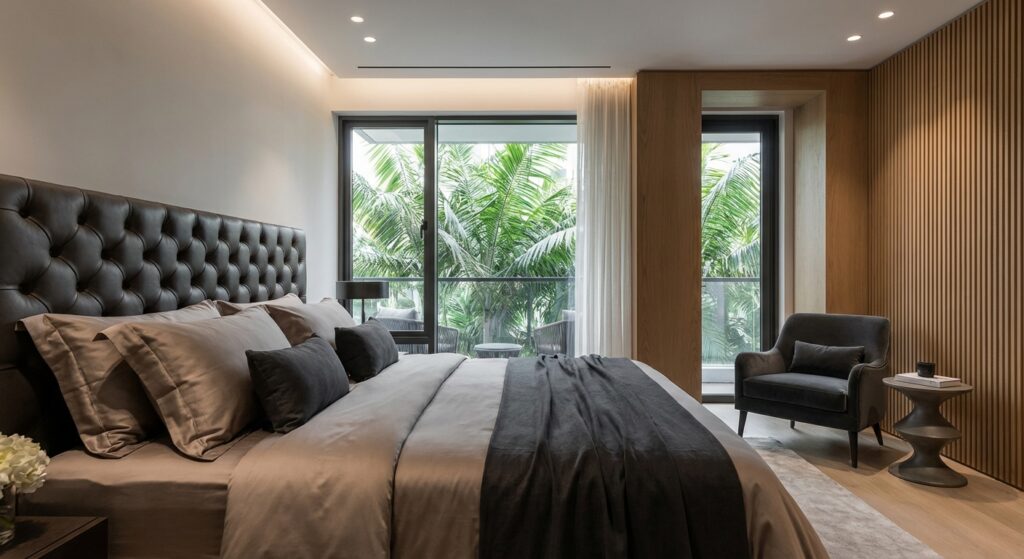
Photography-optimized spaces generate measurable booking advantages. Properties featuring Italian-manufactured furniture from suppliers such as Poliform, Minotti, or B&B Italia command a 23-31% premium over standard furnishings, while reducing vacancy periods by 12-18 days annually. This premium offsets higher acquisition costs within 14-16 months.
Concrete Performance Cases
A 4-bedroom villa in Arabian Ranches underwent $142,000 renovation in January 2023. The project included Poltrona Frau leather seating ($18,500), a custom kitchen installation with Miele appliances ($31,000), and an outdoor entertainment zone with a built-in BBQ and fire pit ($19,500). Pre-renovation monthly income averaged $8,200; post-completion income reached $14,300 monthly. The differential of $6,100 per month yielded complete cost recovery in 23.3 months.
A Palm Jumeirah property received $168,000 in upgrades during Q2 2023, focusing on master suite expansion, imported Italian marble bathrooms, and a complete outdoor redesign. Daily rates increased from $980 to $1,450, with occupancy rising from 71% to 82%. Annual revenue jumped from $254,213 to $434,135, creating $179,922 additional income. Investment recovery occurred in 11.2 months.
Dubai Hills Estate case: $127,000 renovation budget deployed across open-concept living redesign, chef-grade kitchen, and cinema room installation. Monthly net income improved from $11,800 to $18,200. The $6,400 monthly gain delivered payback in 19.8 months.
Operational Variables Affecting Timeline
Seasonal fluctuations require 24-month modeling rather than 12-month projections. Dubai’s tourism patterns show distinct revenue concentration during cooler months. Data from the UK government’s overseas business analysis indicates that November-March generates 58% of annual short-term rental income despite representing 41.6% of calendar days.
Dynamic pricing algorithms employed by professional property managers adjust rates based on 47 variables, including local events, competitor pricing, and booking lead time. Properties lacking professional management typically underperform revenue projections by 18-24%, extending payback periods proportionally.
The effective revenue calculation must account for seasonality:
$$R_{annual} = \sum_{i=1}^{12} (ADR_i \times Occupancy_i \times Days_i) – Operating_{expenses}$$
Where ADR and occupancy vary monthly. Peak season months (December-February) often see ADR increase 35-50% above annual averages, while summer months (June-August) experience 20-30% reductions.
Furniture Durability and Replacement Cycles
Short-term rental properties experience accelerated wear and tear compared to owner-occupied units. Industry data shows that rental furniture requires replacement or significant refurbishment every 3-4 years, compared with 7-10 years for residential use. Italian manufacturers offering hospitality-grade construction extend this cycle to 5-6 years, reducing long-term capital requirements.
A sofa purchased for $4,500 that lasts 3 years costs $1,500 annually; a $8,000 hospitality-grade equivalent that lasts 6 years costs $1,333 annually. The 11% cost reduction compounds across 15-20 furniture pieces in a typical villa, generating $3,000-$5,000 annual savings while maintaining presentation quality.
Tax Optimization and Depreciation Benefits
UAE corporate tax, implemented in 2023, introduced a 9% tax on profits exceeding AED 375,000 ($102,000). Furniture and fixtures qualify for depreciation deductions over their useful lives. According to the UAE Ministry of Finance guidelines, furniture depreciation is calculated using a straight-line method over 5-7 years.
A $150,000 renovation depreciated over 6 years generates $25,000 annual deductions. For properties exceeding the profit threshold, this reduces taxable income by $25,000, saving $2,250 in corporate tax annually. Over 24 months, tax savings contribute $4,500 toward effective cost recovery.
Photography and Marketing Investment
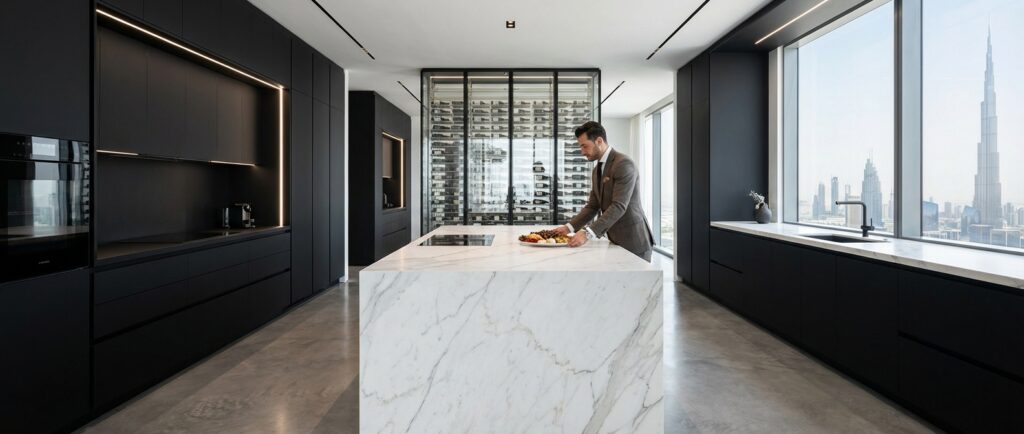
Professional photography costs between $1,200 and $2,800 for luxury villa documentation but generates measurable booking improvements. Properties with professional photography receive 3.2x more inquiry volume and achieve 27% higher conversion rates from inquiry to confirmed booking. The $2,000 median photography investment typically recovers within 45-60 days through reduced vacancy and premium positioning.
Virtual staging and 3D tours add $800-$1,500 to marketing budgets while reducing physical showing requirements by 40-50%. International guests, representing 68% of Dubai’s luxury short-term market, particularly value comprehensive digital previews before committing to bookings.
Competitive Positioning Analysis
Dubai’s short-term rental market contains approximately 28,000 active listings as of Q4 2024. Properties achieving top-quartile performance share common attributes: professional interior design, high-quality photography, responsive management, and consistent positive reviews. The review velocity metric (reviews per month) correlates strongly with occupancy rates.
New renovations trigger algorithmic platform boosts, with Airbnb providing enhanced visibility for 90-120 days following significant updates. Properties maximizing this window through pre-launch marketing and early booking incentives often exceed projected revenue by 15-20% during months 3-6 post-renovation.
Financial Model Sensitivity
The payback period is highly sensitive to occupancy rates and ADR. A 10% decrease in occupancy extends recovery by 2.8-3.4 months in most scenarios. Similarly, 10% ADR reduction adds 2.2-2.6 months to payback timelines.
| Scenario | Monthly Net Income | Recovery Period (months) |
|---|---|---|
| Base Case (78% occupancy, $1,200 ADR) | $17,082 | 8.8 |
| Conservative (68% occupancy, $1,080 ADR) | $12,240 | 12.3 |
| Optimistic (85% occupancy, $1,320 ADR) | $21,450 | 7.0 |
Geographic location remains the dominant variable. Palm Jumeirah properties consistently outperform suburban equivalents by 35-48% in absolute revenue, though acquisition costs run 60-75% higher. The renovation investment as a percentage of property value typically ranges from 8% to 12% for luxury rental optimization.
Implementation Timeline
Renovation execution requires 8-14 weeks, depending on the scope. Italian furniture imports add 6-10 weeks lead time, necessitating early supplier engagement. Properties remaining operational during renovation lose 100% of rental income; complete closure for 10-12 weeks, followed by professional staging, proves more efficient than phased work that extends 20-24 weeks.
The optimal renovation calendar starts in April-May, targeting completion by October to capture peak season. Properties missing November-December booking windows miss out on 20-24% of their first-year post-renovation revenue potential.
Dubai’s rental market dynamics favor well-capitalized renovations executed rapidly over budget-constrained phased approaches. The 24-month recovery framework assumes professional execution, premium material selection, and active revenue management. Properties meeting these criteria consistently achieve their stated targets, while those that compromise on design quality, furniture grade, or operational standards require 30-42 months for comparable returns.